Free Consultation Today
Current Clients
Free Consultation Today
Current Clients
Texas residents carry a mix of mortgage, credit card, and consumer debt. This page explores current debt trends across the state, including credit usage, delinquency rates, and what they reveal about financial pressure.
Get your FREE
Quote Today
By providing your information, you agree to Greenwise Financial Solution’s terms of use and privacy policy.

Texas represents one of the largest and fastest-growing economies in the United States. Despite its economic strength, households across the state carry a wide range of financial obligations, including mortgages, credit cards, auto loans, and student loans.
Compared to the national average, Texans carry approximately $3,800 less total debt per adult with a credit score as of 2024. This places Texas in a moderate position relative to other states—lower than high-cost states like California, but still representing a significant financial burden.
Mortgage debt remains the largest component of household debt in Texas, accounting for approximately 64.4% of total household debt. This reflects both population growth and continued demand for housing across the state.
Credit card debt plays a central role in Texas households, particularly because of the widespread use of revolving credit.
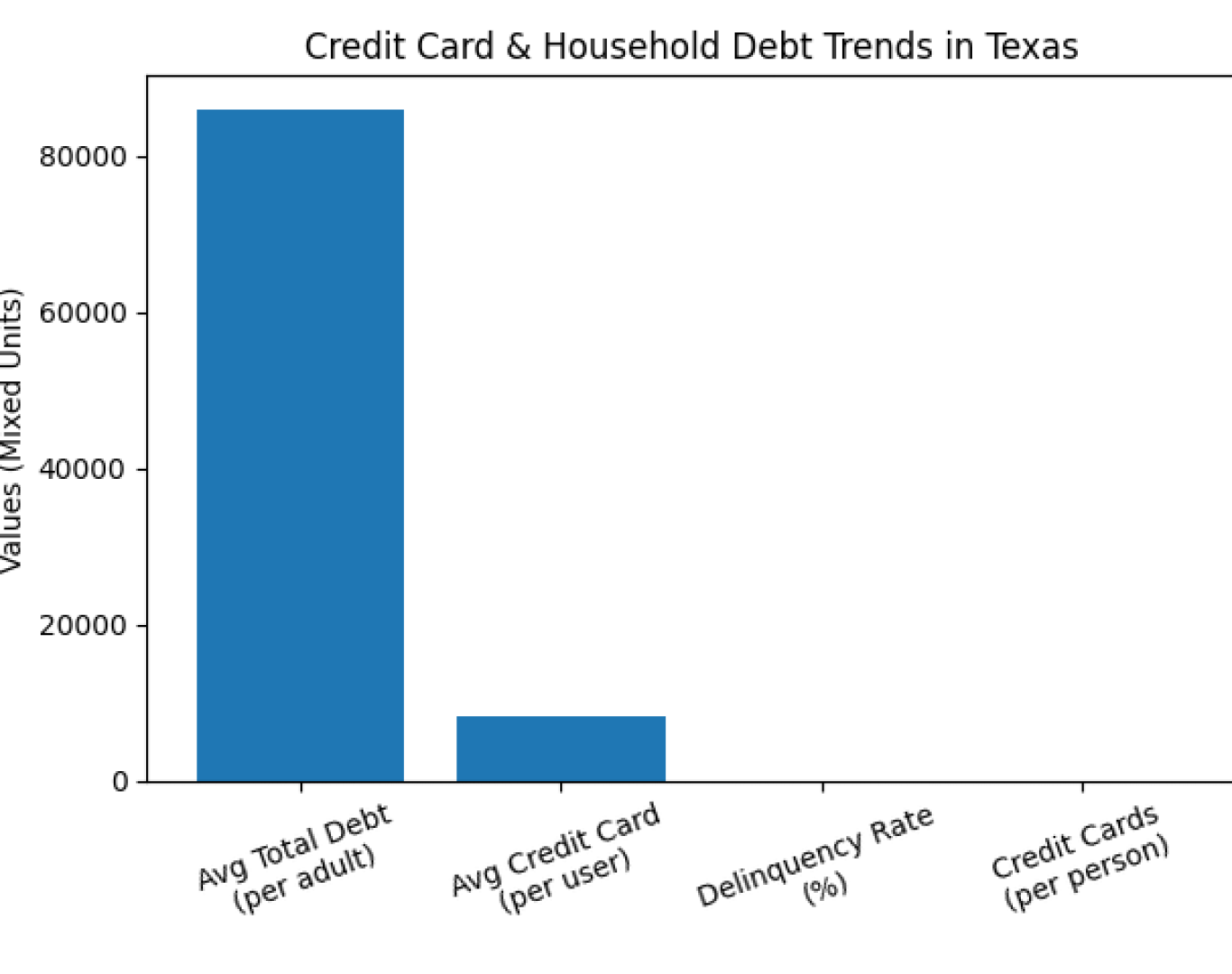
Recent estimates show that the average credit card balance per user in Texas is approximately $8,186 as of 2026. In addition, Texans hold an average of 3.18 credit cards per person, indicating relatively high reliance on credit.
While this balance is lower than states like California, the number of accounts per individual suggests that many residents manage multiple credit lines simultaneously. This can make financial organization more complex and increase the risk of missed payments or growing balances.
For individuals managing several accounts, strategies such as credit card consolidation or credit card relief

One of the strongest indicators of financial pressure is delinquency—when borrowers fall behind on payments.
In California, approximately 11% of credit card holders have balances that are 90 days or more overdue, indicating a notable level of financial strain among borrowers.
Additionally, 24.8% of cardholders use more than 75% of their available credit limit, which is considered high credit utilization. High utilization not only increases financial pressure but can also negatively impact credit scores and borrowing ability.
These patterns suggest that many individuals are operating close to their credit limits, which can make it more difficult to recover financially without structured repayment strategies.
Credit utilization is an important measure of financial health. It reflects how much of a person’s available credit is being used.
In Texas, the average number of credit cards per person—over three accounts per individual—suggests a higher reliance on revolving credit compared to many other states.
At the same time, Texas ranks among the states with elevated levels of financial distress. Factors such as debt levels, credit scores, and forbearance rates indicate that many households are operating under financial pressure.
High credit utilization combined with multiple accounts can make it more difficult to manage payments effectively, especially when interest rates remain elevated.
Understanding how debt is distributed across different categories provides a clearer picture of financial behavior in Texas.
Mortgages account for approximately 64.4% of total household debt, making them the largest financial obligation for most residents.
Credit cards represent the most common form of unsecured debt and are often associated with higher interest rates and revolving balances.
Auto loans are particularly significant in Texas due to the state’s reliance on personal vehicles. Many households carry vehicle financing as part of their overall debt profile.
Student debt also contributes to long-term financial obligations, often overlapping with other types of consumer debt.
This distribution highlights how both long-term and short-term borrowing shape the financial landscape across the state.
One of the most telling indicators of financial strain is the rate of bankruptcy filings.
Texas has experienced a 22% increase in personal bankruptcy filings between 2024 and 2025, signaling rising financial challenges for many households.
Additionally, approximately 7.1% of financial accounts in Texas are in distress or forbearance, placing the state among the highest nationally in terms of financial strain.
These trends suggest that many individuals are reaching a point where traditional repayment methods become difficult to sustain. As a result, structured financial strategies may become increasingly important for managing debt effectively.
Credit scores play a major role in determining access to financial products such as loans, refinancing options, and credit lines.
Texas residents have below-average credit scores nationally, ranking around 13th lowest among U.S. states. Lower credit scores can limit access to favorable interest rates and traditional lending options.
This can create additional challenges for individuals seeking to refinance or restructure their debt. As a result, alternative financial strategies such as
credit card relief programs may become more relevant for those who do not qualify for traditional lending solutions.
Texas presents a unique financial profile compared to other states. While overall debt levels are lower than high-cost states like California, the combination of high credit usage, rising delinquency rates, and increasing financial distress creates a different kind of challenge.
This “moderate but stressed” position means that many households may not have the highest debt totals, but they still experience difficulty managing their financial obligations.
Understanding these trends helps individuals better evaluate their financial situation and consider strategies that improve organization, reduce financial pressure, and support long-term stability.
Because credit card balances often carry higher interest rates, many financial strategies focus on addressing revolving debt first.
Structured approaches such as consolidation, negotiated repayment plans, and guided financial programs can help individuals simplify their financial obligations.
For example: credit card consolidation services can combine multiple balances into one payment, making it easier to manage repayment.
Similarly, credit card relief programs can provide structured options for individuals experiencing financial pressure.
These strategies focus on improving financial organization and helping individuals work toward long-term financial stability.
A simplified overview of key financial data:

Texans carry about $3,800 less total debt per adult compared to the national average, placing the state slightly below overall U.S. debt levels.
The average credit card balance per user in Texas is approximately $8,186, with individuals holding multiple credit cards on average.
Approximately 11.19% of credit card accounts are delinquent, indicating a notable level of financial strain.
Rising delinquency rates, increased bankruptcy filings, and high credit usage all contribute to growing financial pressure across the state.
Most households carry some form of debt, with mortgages, credit cards, and auto loans representing the largest categories.